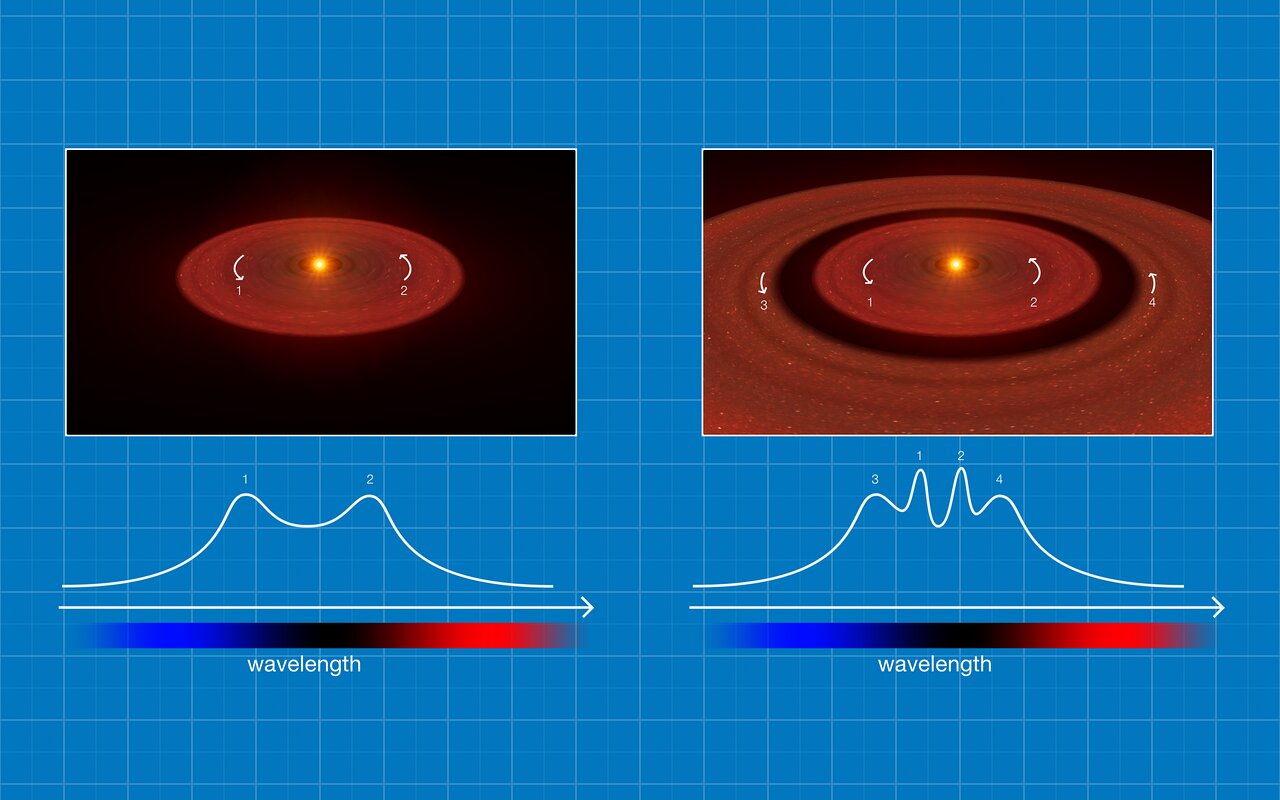
Detecting two rings of debris around the white dwarf J1328−1450
Bild: ESO/L. Calçada, CC BY 4.0
This diagram shows how astronomers can infer the presence of a gaseous disc around a star. Gas only emits light at very specific colours or wavelengths, which can be observed with a spectrograph. This characteristic wavelength will shift to bluer or redder colours if the gas is moving towards us or away from us, respectively. In the gas is rotating around a star, one side of the disc is approaching us and the other one is receding, so its spectrum exhibit two peaks shifted to blue and red colours, as seen to the left of this diagram. The faster the disc spins, the further away the peaks will be from each other. If there are two concentric gas discs, each will produce its own pair of peaks in the spectrum, because they move at different velocities. The outer disc rotates slower than the inner one, so its two peaks are closer to each other.
Titel, Beschreibungen und Bildangaben erscheinen auf Englisch, so wie die Quelle sie veröffentlicht.
Bei ESO ansehen