James Webb Space Telescope: der Plan dieser Woche
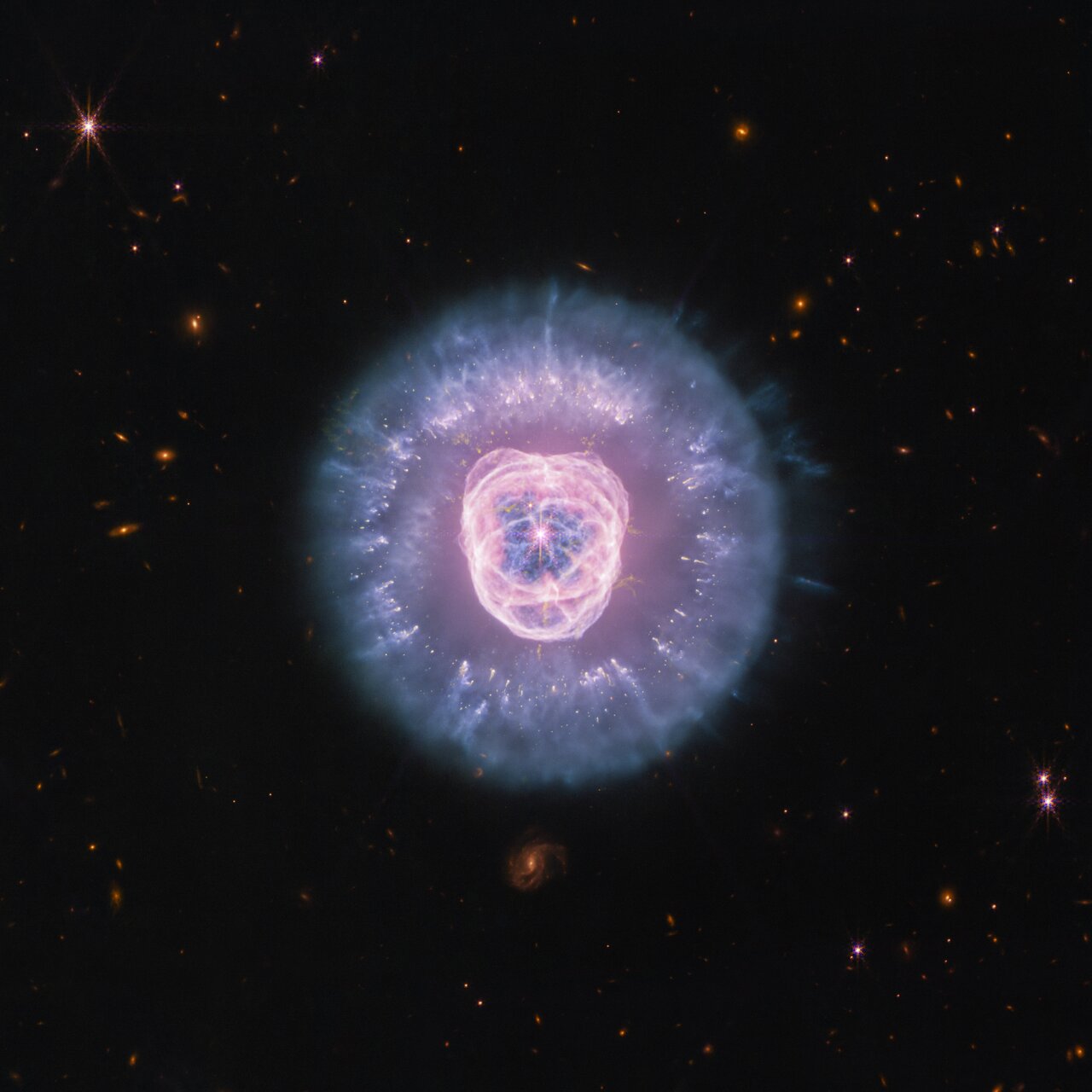
Dies ist eine Webb-Aufnahme
NGC 2392 (Lion Nebula)
Früher bekannt als: Eskimo Nebula
Webb sieht Infrarot, also Wärme statt Licht, das Ihr Auge wahrnehmen kann, hier gab es also keine Farbe zu fotografieren. Jede Farbe in diesem Bild steht für eine der Wellenlängen, die Webb aufgezeichnet hat, und so wird unsichtbares Licht sichtbar gemacht.
Wofür jede Farbe steht
Ein Mikrometer (µm) ist ein Tausendstel Millimeter. Ihr Auge sieht nur bis etwa 0,7, jede der folgenden Wellenlängen liegt also darüber hinaus.
- Blau: 1,15 µm (NIRCam)
- Cyan: 1,87 µm (NIRCam)
- Gelb: 2,12 µm (NIRCam)
- Orange: 3,35 µm (NIRCam)
- Rot: 10 µm (MIRI)
Veröffentlicht: 2026-08-10
Bildnachweis: NASA, ESA, CSA, STScI. Image Processing: A. Pagan (STScI). CC BY 4.0
Diese Veröffentlichung auf esawebb.org ansehenDie vollständige Bildbeschreibung der ESA lesen (auf Englisch)
Planetary nebula NGC 2392, also called the Lion Nebula, against the black background of space. The nebula is in the centre, circular in shape, and looks like a male lion’s head. In the very centre is a small, pinkish-white circle with eight-point diffraction spikes, a white dwarf star. Surrounding the star are light purple-pink cavernous bubbles and shell-like rings. The bubbles and shells collectively form an oval with two small, wide arcs near the top, reminiscent of a lion’s face and its ears. What appears to be extended outward from the lion’s face is a thick ring of purple-blue material. The width of the ring is consistent throughout and resembles a mane. The area closest to the lion’s face looks cloudy, while the edges of the mane look like there are clumps of dust with comet-like tails and strands. In the background are distant galaxies and stars. Some galaxies appear as small yellow and orange points of light and others with visible spiral structures. A couple of the stars have diffraction spikes.
Textnachweis: ESA/Webb, CC BY 4.0
Das ist ein Plan, keine Liveübertragung
Keine öffentliche Quelle meldet, wohin Webb gerade tatsächlich zielt. Unten steht der Plan, den das STScI im Voraus veröffentlicht hat. Ein Teil davon wird nicht stattfinden: kurzfristige Gelegenheitsziele, etwa eine plötzliche Supernova, können geplante Beobachtungen verdrängen.
Since the schedules do not take into account unforeseen events, including some target of opportunity observations, it is possible that the actual executed observations will differ from those planned.Der Plan dieser Woche wird geladen.