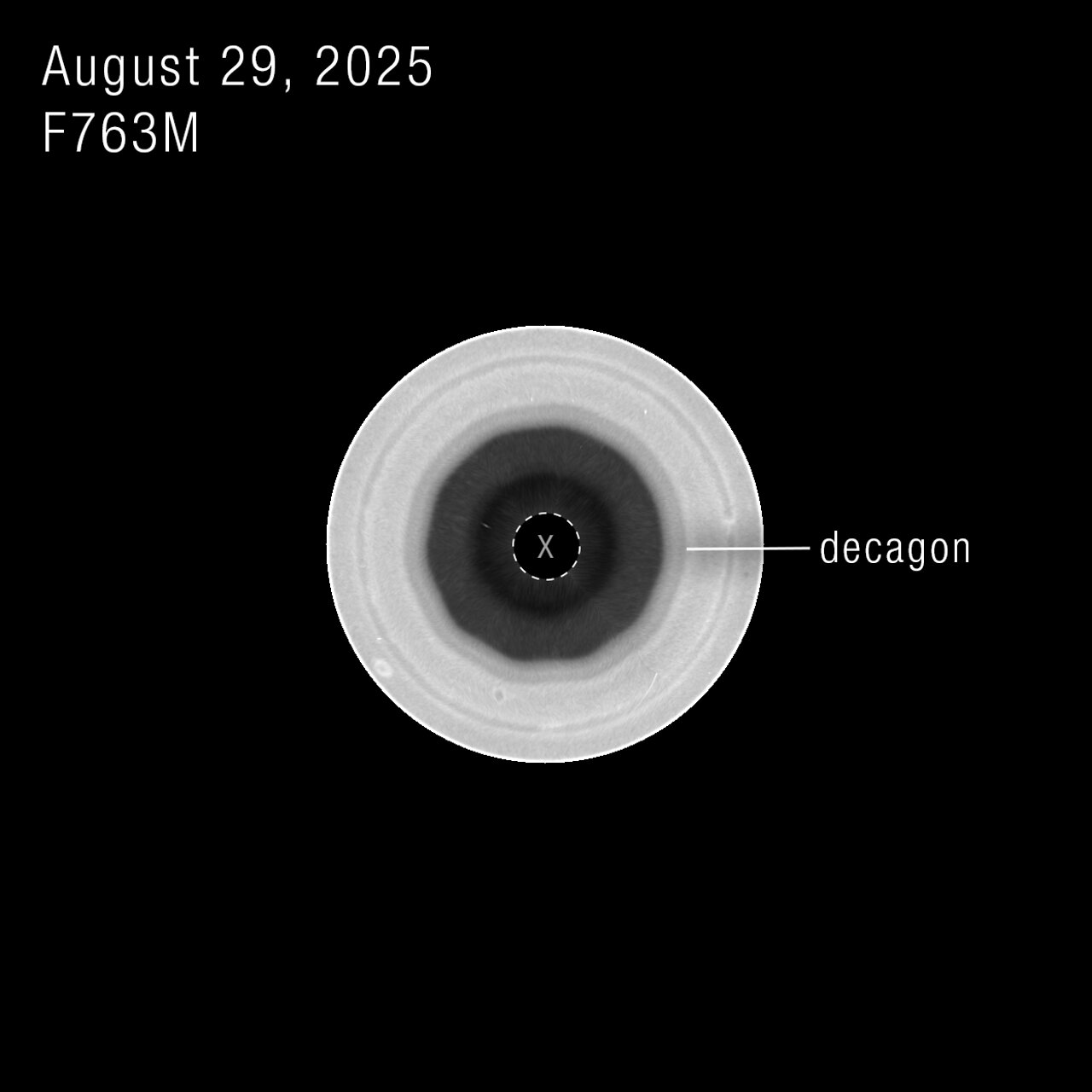
Decagon on Saturn’s south pole (single filter image)
Credit: NASA, ESA, STScI, A. Sánchez-Lavega (University of the Basque Country), A. Simon (NASA-GSFC), M. Wong (UC Berkeley); Image Processing: A. Pagan (STScI), CC BY 4.0
A single wavelength of light from the NASA/ESA Hubble Space Telescope provides a particularly clear view of the 10-sided atmospheric wave discovered encircling Saturn’s south pole. The feature, labeled “decagon,” is embedded within one of Saturn’s powerful jet streams. The wave is centered around 63 degrees south latitude, and its apparent position shifts slightly depending on the wavelength of light observed. Observations from Hubble at different wavelengths of light reveal the structure at different altitudes. Hubble observations also show that the feature was present as early as 2023 and has become more pronounced over subsequent years. The “X” and dashed circle in the image represents where data was not captured by Hubble. [Image description: A black and white view of Saturn’s south pole, labeled “August 29, 2025” and “F763M.” The south-polar view of Saturn shows concentric bands of its atmosphere, transitioning from bright outer bands to a dark central region outlined in a 10-sided pattern. This outline is labeled “decagon.” A small, dashed circle at the very center of the pole with an “X” inside denotes missing data.]
Titles, descriptions and credits are shown in English, as the source publishes them.
View at ESA/Hubble