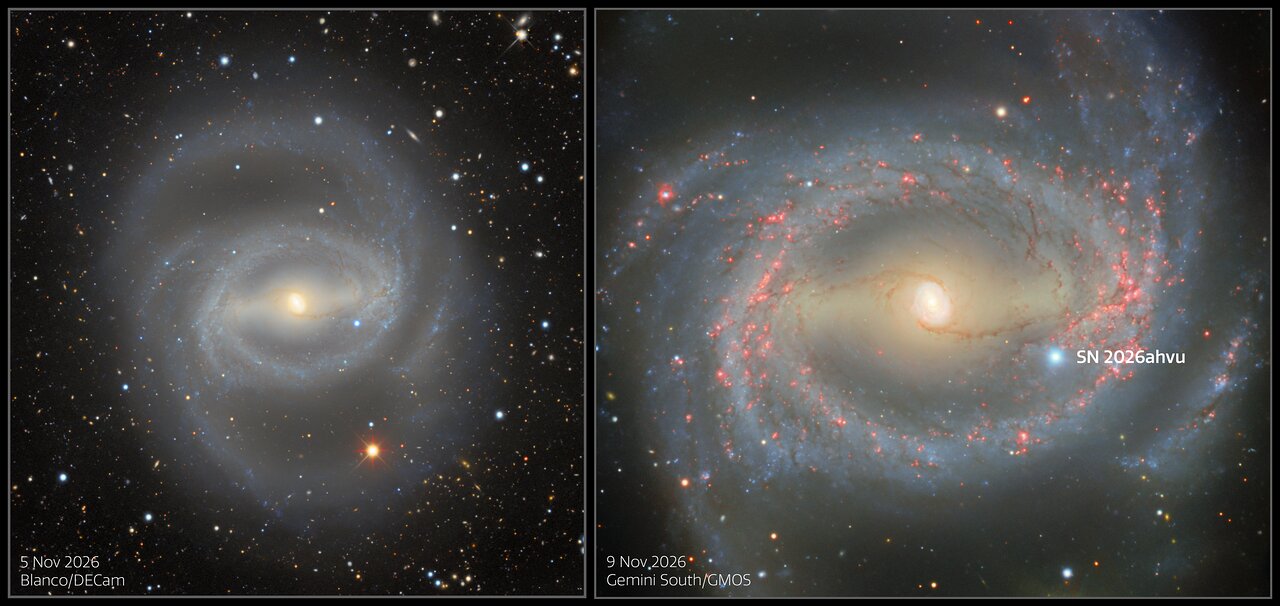
Infographic of supernova SN 2026ahvu (Blanco/DECam and Gemini South/GMOS)
Credit: Dark Energy Survey/DOE/FNAL/DECam/CTIO/International Gemini Observatory/NOIRLab/NSF/AURA Acknowledgment: PIs: G. Narayan & T. Murphey (University of Illinois at Urbana-Champaign) / S. Dahm (NSF NOIRLab/Gemini) Image processing: J. Miller & M. Rodriguez (International Gemini Observatory/NSF NOIRLab), T.A. Rector (University of Alaska Anchorage/NSF NOIRLab), D. de Martin & M. Zamani (NSF NOIRLab), CC BY 4.0
Newly discovered supernova SN 2026ahvu is seen here in the nearby spiral galaxy NGC 1433. The supernova appears as a very bright point of light to the right and slightly below the center of the galaxy. This left image was captured by the U.S. Department of Energy-fabricated-Dark Energy Camera (DECam), mounted on the U.S. National Science Foundation Víctor M. Blanco 4-meter Telescope at Cerro Tololo Inter-American Observatory (CTIO), a Program of NSF NOIRLab. The final composite includes observations of NGC 1433 taken from 2013–2018, as well as on 5 November 2026. The right image was captured by the Gemini South telescope in Chile using its Gemini Multi-Object Spectrograph (GMOS). Gemini South is one half of the International Gemini Observatory, an international collaboration led by the NSF, in partnership with Canada, Chile, Brazil, Argentina, and the Republic of Korea, and operated by NSF NOIRLab. Caught early and still approaching its expected maximum brightness, SN 2026ahvu gives astronomers a valuable opportunity to study a stellar explosion as it unfolds. NSF NOIRLab is coordinating observations across the facilities it operates, working with its partners to maximize scientific return, and inviting other observatories to join the effort.
Titles, descriptions and credits are shown in English, as the source publishes them.
View at NSF NOIRLab