James Webb Space Telescope: this week's plan
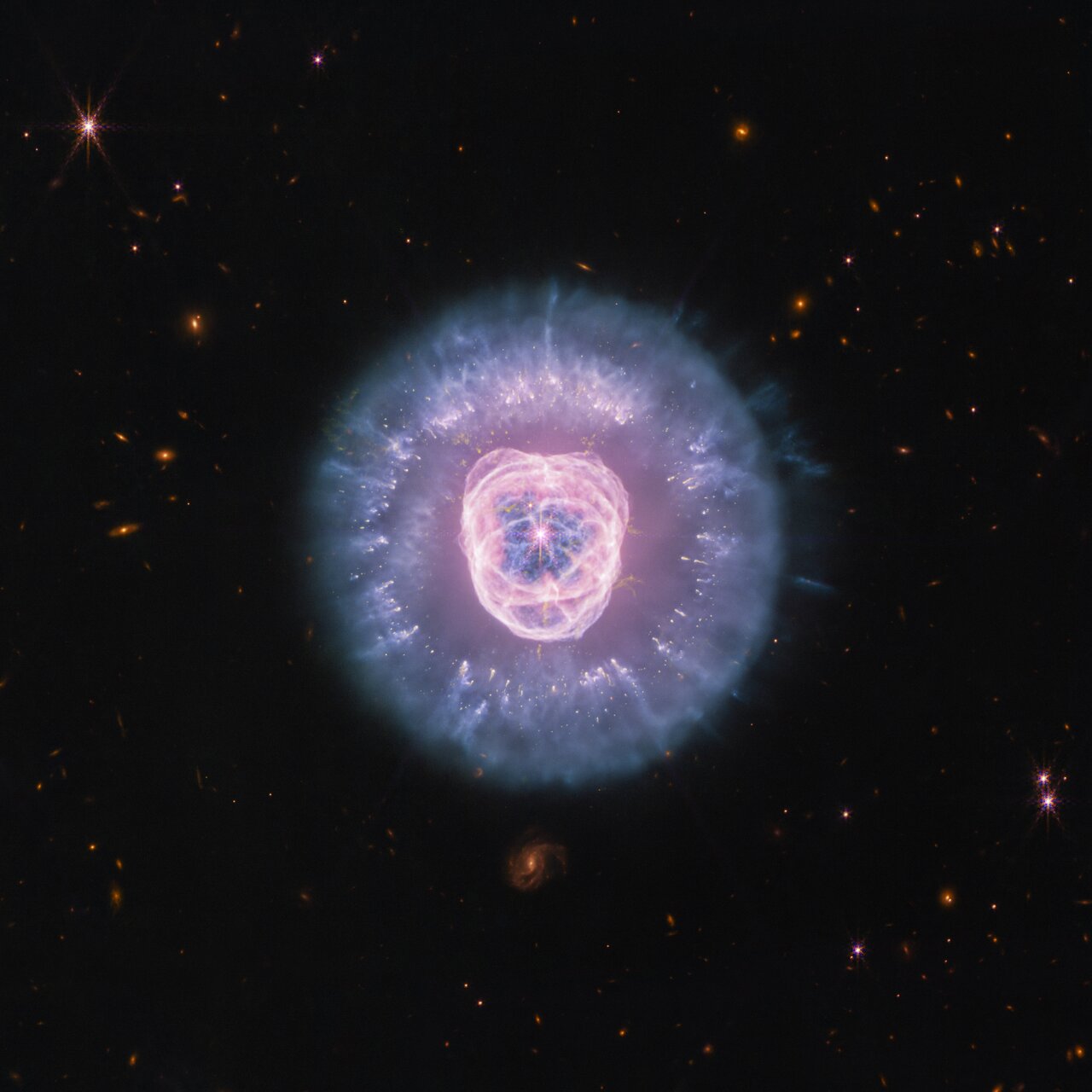
This is a Webb image
NGC 2392 (Lion Nebula)
Formerly known as: Eskimo Nebula
Webb sees infrared, which is heat rather than light your eye can detect, so there was no colour here to photograph. Each colour in this picture stands for one of the wavelengths Webb recorded, which is how invisible light is made visible.
What each colour stands for
A micrometre (µm) is a thousandth of a millimetre. Your eye stops seeing at about 0.7, so every wavelength below is beyond it.
- Blue: 1.15 µm (NIRCam)
- Cyan: 1.87 µm (NIRCam)
- Yellow: 2.12 µm (NIRCam)
- Orange: 3.35 µm (NIRCam)
- Red: 10 µm (MIRI)
Released: 2026-08-10
Image credit: NASA, ESA, CSA, STScI. Image Processing: A. Pagan (STScI). CC BY 4.0
View this release on esawebb.orgRead ESA's own description of this picture
Planetary nebula NGC 2392, also called the Lion Nebula, against the black background of space. The nebula is in the centre, circular in shape, and looks like a male lion’s head. In the very centre is a small, pinkish-white circle with eight-point diffraction spikes, a white dwarf star. Surrounding the star are light purple-pink cavernous bubbles and shell-like rings. The bubbles and shells collectively form an oval with two small, wide arcs near the top, reminiscent of a lion’s face and its ears. What appears to be extended outward from the lion’s face is a thick ring of purple-blue material. The width of the ring is consistent throughout and resembles a mane. The area closest to the lion’s face looks cloudy, while the edges of the mane look like there are clumps of dust with comet-like tails and strands. In the background are distant galaxies and stars. Some galaxies appear as small yellow and orange points of light and others with visible spiral structures. A couple of the stars have diffraction spikes.
Text credit: ESA/Webb, CC BY 4.0
This is a plan, not a live feed
No public source reports where Webb is actually pointing right now. What you see below is the schedule STScI published in advance. Some of it will not happen: targets of opportunity, such as a sudden supernova, can push planned observations aside at short notice.
Since the schedules do not take into account unforeseen events, including some target of opportunity observations, it is possible that the actual executed observations will differ from those planned.Reading this week's schedule.