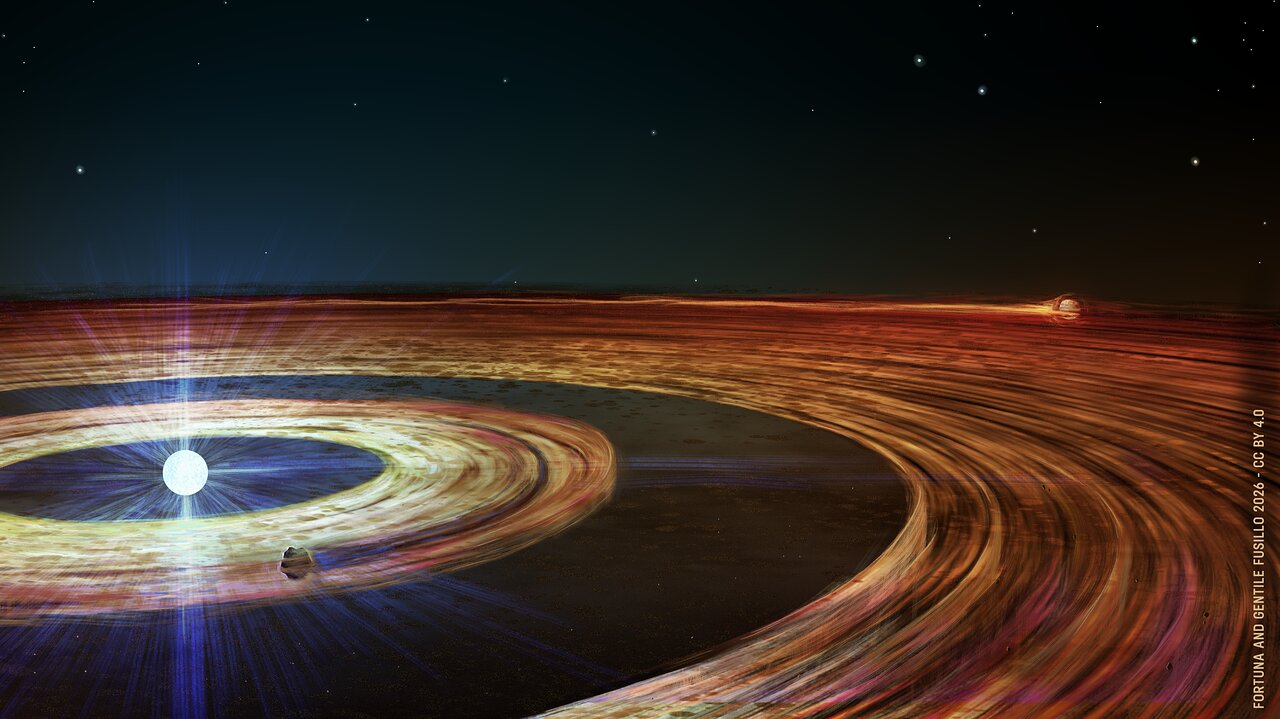
Alternative artist’s impression of the debris disc around the white dwarf J1328−1450
Crédit : Fortuna and Gentile Fusillo, CC BY 4.0
This illustration shows a debris disc around the white dwarf J1328−1450 –– the dead core of a star similar to our Sun that expelled its outer layers at the end of its lifetime. The star was suspected to have a planetary system that was vaporised to rubble as the star died, and this debris ended up arranged in a disc like the one shown here. The disc contains both gas and dust, but the gas appears to be arranged in a unique way. Using the X-shooter instrument on ESO’s Very Large Telescope (VLT) astronomers measured the speed of the gas orbiting the white dwarf, and found that it moves at two distinct speeds. This indicates that the gas is distributed in two concentric discs with a gap in between. The most likely explanation is that these two gaseous discs are maintained by two planetesimals that survived the death of the star. As they orbit the white dwarf they interact with dust grains in the disc, releasing gas in the process. While the planetesimals themselves can’t be directly detected, astronomers can infer their size based on their distance the white dwarf. The closer they are to it, the smaller they can be before they are destroyed by the tidal forces of the white dwarf. The inner planetesimal should therefore be a few tens of kilometres wide, like an asteroid, whereas the outer one could be as big a Pluto. This artist’s impression was created by Maria Cristina Fortuna in collaboration with the lead author of the paper.
Les titres, descriptions et crédits sont affichés en anglais, tels que la source les publie.
Voir sur ESO