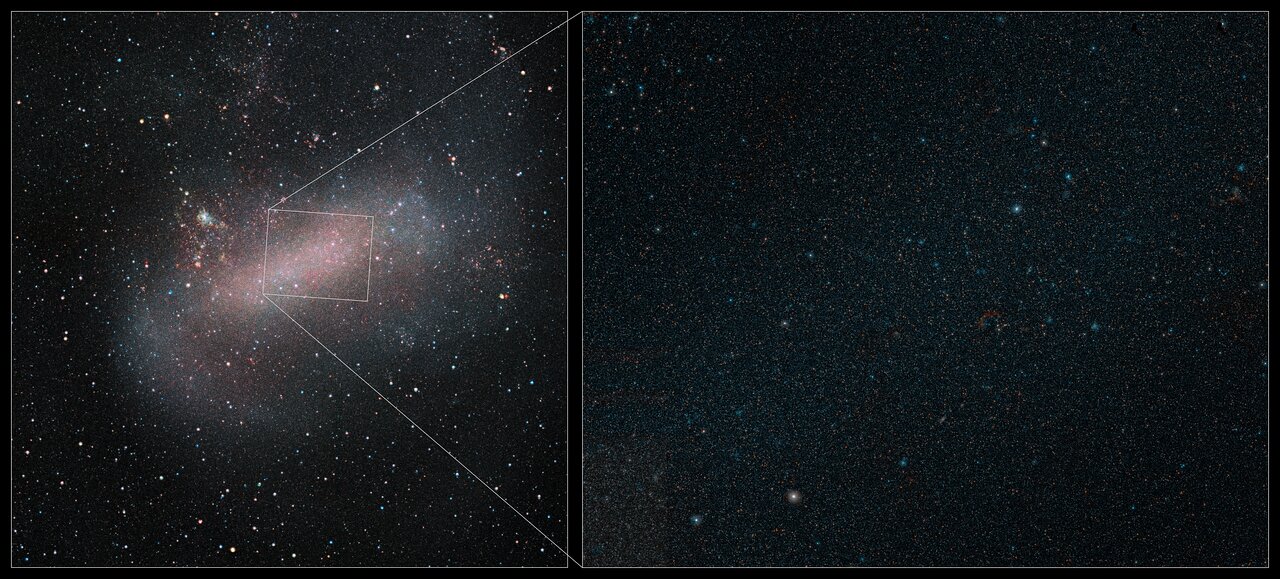
A starry night, in another galaxy
Crédit : ESO/M.-R. Cioni et al. CC BY 4.0
When we look up at our own night sky, most of the stars we see are the familiar residents of our Milky Way galaxy. Only a few more distant objects, like the Large and Small Magellanic Clouds, our neighbouring galaxies, peek into our little corner of the cosmos. What this Picture of the Week shows us is a completely different stellar landscape, zooming in to the centre of the Large Magellanic Cloud to reveal what looks like a sky filled with millions of foreign stars. The central regions of galaxies are hard to study: dust partially blocks our view, and stars are so densely packed that it’s difficult to tell them apart. To uncover these hidden stars in the Magellanic Clouds, astronomers used ESO's Visible and Infrared Survey Telescope for Astronomy (VISTA). Over several years, VISTA's high-resolution infrared camera pierced through the dust to image the cores of these galaxies, finding a treasure trove of information about the inner lives of our nearest galactic neighbours. The team, led by Maria-Rosa Cioni, a professor at the Leibniz Institute for Astrophysics in Potsdam, Germany, observed these galactic cores about 40 times over this extended period. With these data, they could then measure the subtle motion of stars in the cores, which is key to pinpoint the exact location of the centres of these galaxies. As well as this, by monitoring the periodic changes in the brightness of certain stars, which can be used to measure distances, astronomers will be able to reconstruct the 3D structure of the cores of these galaxies. Now that this unique dataset has been publicly released, the wider astronomical community can also access the information within, potentially digging up more secrets from deep inside our cosmic companions. Links Deep VISTA image of the Small Magellanic Cloud Video panning over the Magellanic Clouds Research paper accepted for publication in Astronomy & Astrophysics
Les titres, descriptions et crédits sont affichés en anglais, tels que la source les publie.
Voir sur ESO