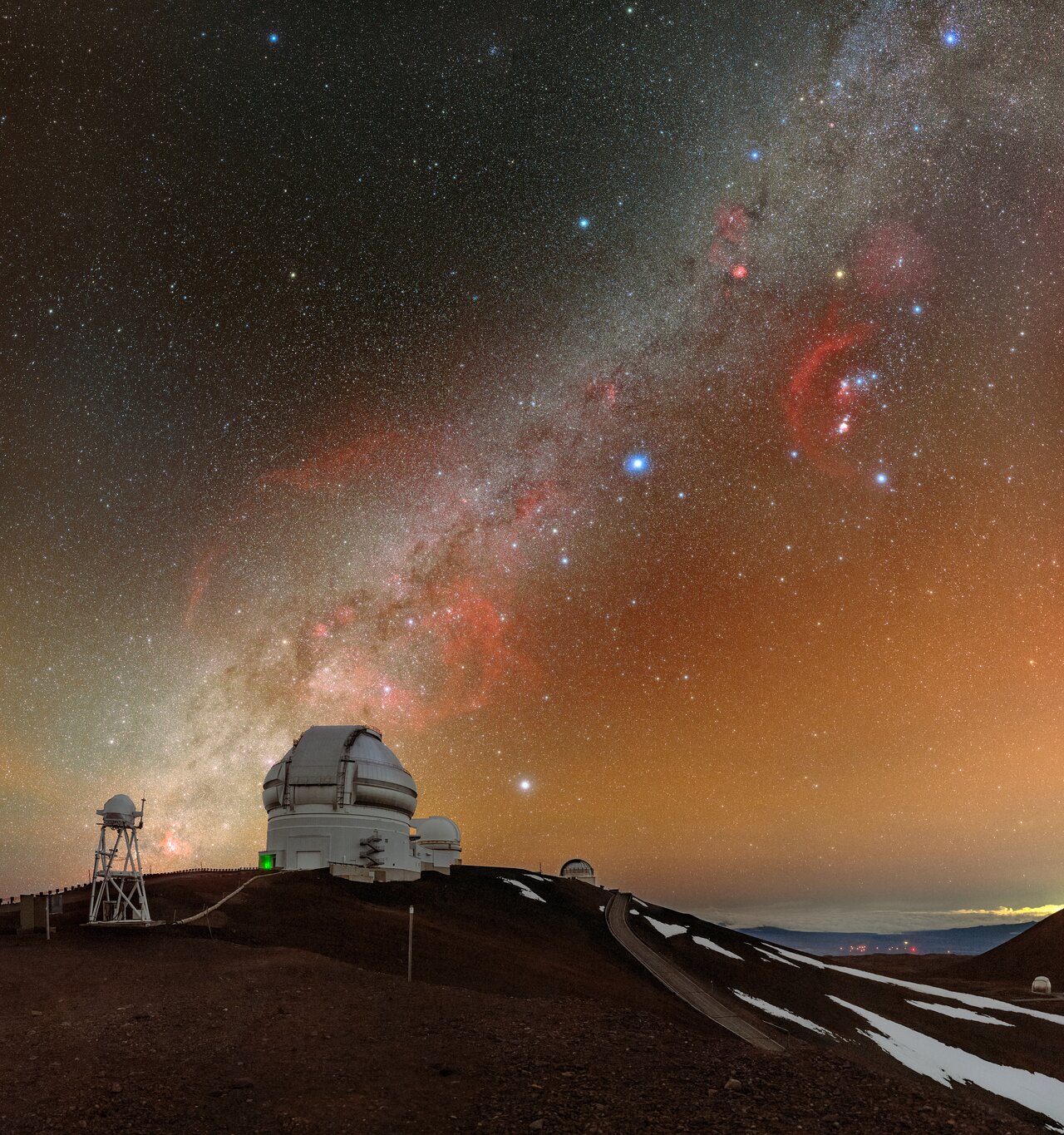
Let’s Go, Airglow!
Crédit : International Gemini Observatory/NOIRLab/NSF/AURA/T. Slovinský, CC BY 4.0
A color-packed sky full of brilliant orange airglow hangs over Gemini North in Hawai‘i. The Gemini North telescope is one half of the International Gemini Observatory, supported in part by the U.S. National Science Foundation (NSF) and operated by NSF NOIRLab. In the top right of this image, we see the constellation Orion (The Hunter). Three red emission nebulae of the Orion molecular cloud complex are vividly captured in this photo: The Orion Nebula (Messier 42) in the middle of Orion’s sword, the large Barnard’s Loop (Sh 2-276) around Orion’s lower half, and the faint Lambda Orionis Ring (Sh 2-264) around his head. Orion is joined on the left by Canis Major (the greater dog), featuring the brightest star in the night sky, Sirius. Further to the left, above Gemini North, is the massive Gum Nebula (Gum 12). The wash of orange airglow is caused by sunlight energizing atoms and molecules in the Earth’s atmosphere during the day. The atoms and molecules then shed this excess energy by emitting light at night. The color of the airglow corresponds to the type of atom or molecule. Orange light comes from the sodium layer of the Earth’s atmosphere, located about 80–105 km (50–65 miles) above sea level. Gemini North is joined in this image by the Maunakea Atmospheric Monitor (left). Also visible are the University of Hawai‘i 2.2-meter Telescope to the immediate right of Gemini, and the United Kingdom Infrared Telescope to the right of that. In the distance on the far right is the Caltech Submillimeter Observatory. This photo was taken as part of the NOIRLab 2022 Photo Expedition to all the NOIRLab sites. Tomáš Slovinský, the photographer, is a NOIRLab Audiovisual Ambassador.
Les titres, descriptions et crédits sont affichés en anglais, tels que la source les publie.
Voir sur NSF NOIRLab