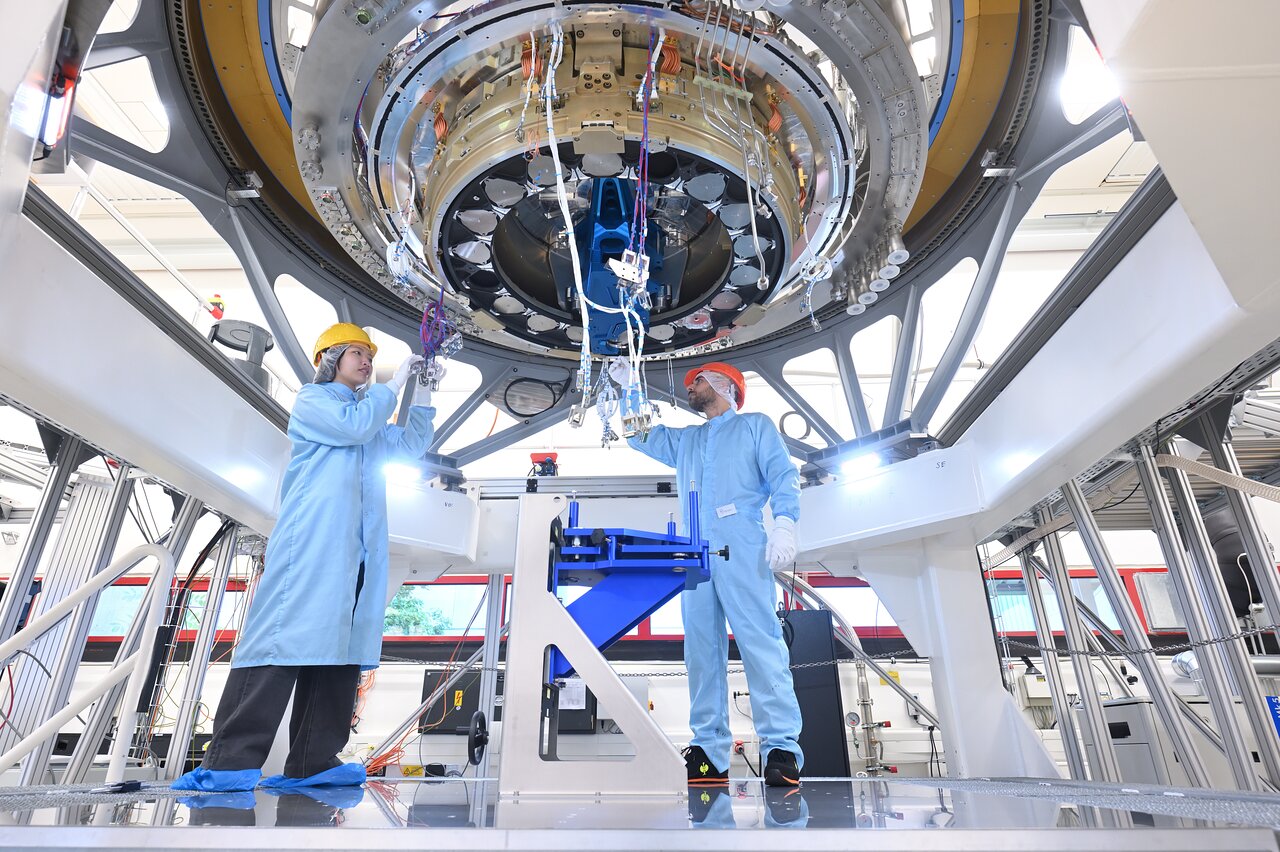
A wheel fit for a giant
Autorzy: MPE/NOVA/F. Kamphues, CC BY 4.0
In a cleanroom at the Max Planck Institute for Extraterrestrial Physics (MPE) in Garching, Germany, two engineers look up at the heart of MICADO. One of the first instruments that will operate on ESO's Extremely Large Telescope (ELT) in Chile’s Atacama Desert, MICADO will observe the Universe in the infrared, and each slot in this giant rotating wheel carries a different filter that lets light through at different colours or wavelengths. This so-called Centre Wheel Mechanism was built by the Netherlands Research School of Astronomy (NOVA), part of the MICADO consortium, led by MPE. What makes this photograph so astounding is the sheer scale of the device compared to the engineers working on it, Jeongha Lee and Federico Biondi. In today’s telescopes, a filter wheel is typically a few tens of centimetres across. This mechanism measures about 1.5 metres — an extremely large telescope, it turns out, also demands extremely large instruments. Size is only part of the challenge. Since MICADO observes at infrared wavelengths, the mechanism has to work at cryogenic temperatures to prevent its thermal glow from contaminating the observations. But materials behave differently at very low temperatures, which complicates the accurate positioning of the optical elements in this wheel. Some of them, like special masks that will be used to observe planets around other stars, need to be placed with an accuracy of just a few microns, which is less than the width of a human hair. Once in place in Chile, MICADO will image the Universe with a sensitivity comparable to the NASA/ESA/CSA James Webb Space Telescope, but six times sharper. It will pick out individual stars in distant galaxies, characterise planets outside the Solar System, and track the stars orbiting the supermassive black hole at the centre of the Milky Way. For now, though, it is taking shape in Garching, a few hundred metres from ESO’s Headquarters, a whole hemisphere away from the mountain where it will eventually get to work.
Tytuły, opisy i podpisy autorów są pokazane po angielsku, tak jak publikuje je źródło.
Zobacz w ESO