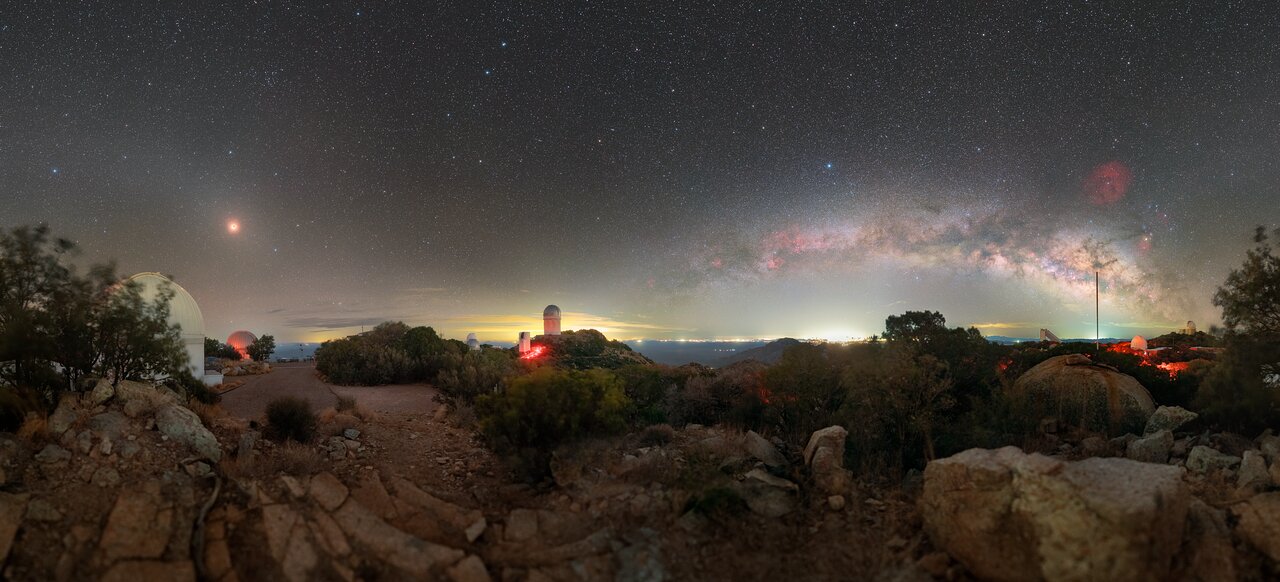
All-Nighter on Kitt Peak
Autorzy: KPNO/NOIRLab/NSF/AURA/P. Horálek (Institute of Physics in Opava), CC BY 4.0
There’s never a quiet moment at U.S. National Science Foundation (NSF) Kitt Peak National Observatory (KPNO). Between the busy night sky and the fleet of telescopes keeping watch, every night is an all-nighter. KPNO is a Program of NSF NOIRLab. In this photo, you can see the Burrell Schmidt Telescope (foreground) and SARA Kitt Peak Telescope (middle ground) on the left, with the full Moon hanging above. If you look closely, you’ll see that it’s not just any full Moon — this photo was taken during the total lunar eclipse on 3 March 2026. You can find the previous NOIRLab Image of the Week of this eclipse here. In the center of the image sits (left to right) the UA 0.9-meter Spacewatch Telescope, UA 1.8-meter Spacewatch Telescope, UA Bok 2.3-meter Telescope, and the NSF Nicholas U. Mayall 4-meter Telescope, framed by a thin layer of stratus clouds. Making your way around the image, the brilliant band of the Milky Way arcs towards another cluster of telescopes (left to right): the NSF McMath-Pierce Solar Telescope, the Robotically Controlled Telescope, and the KPNO 2.1-meter Telescope. Above the Milky Way is the red emission nebula known as Sh2-27, visible as a red splotch surrounding the star Zeta Ophiuchi, while the city lights of nearby Tucson, Arizona, brighten the horizon below. You can also explore this image as a 360 panorama and fulldome. Petr Horálek, the photographer, is a NOIRLab Audiovisual Ambassador.
Tytuły, opisy i podpisy autorów są pokazane po angielsku, tak jak publikuje je źródło.
Zobacz w NSF NOIRLab