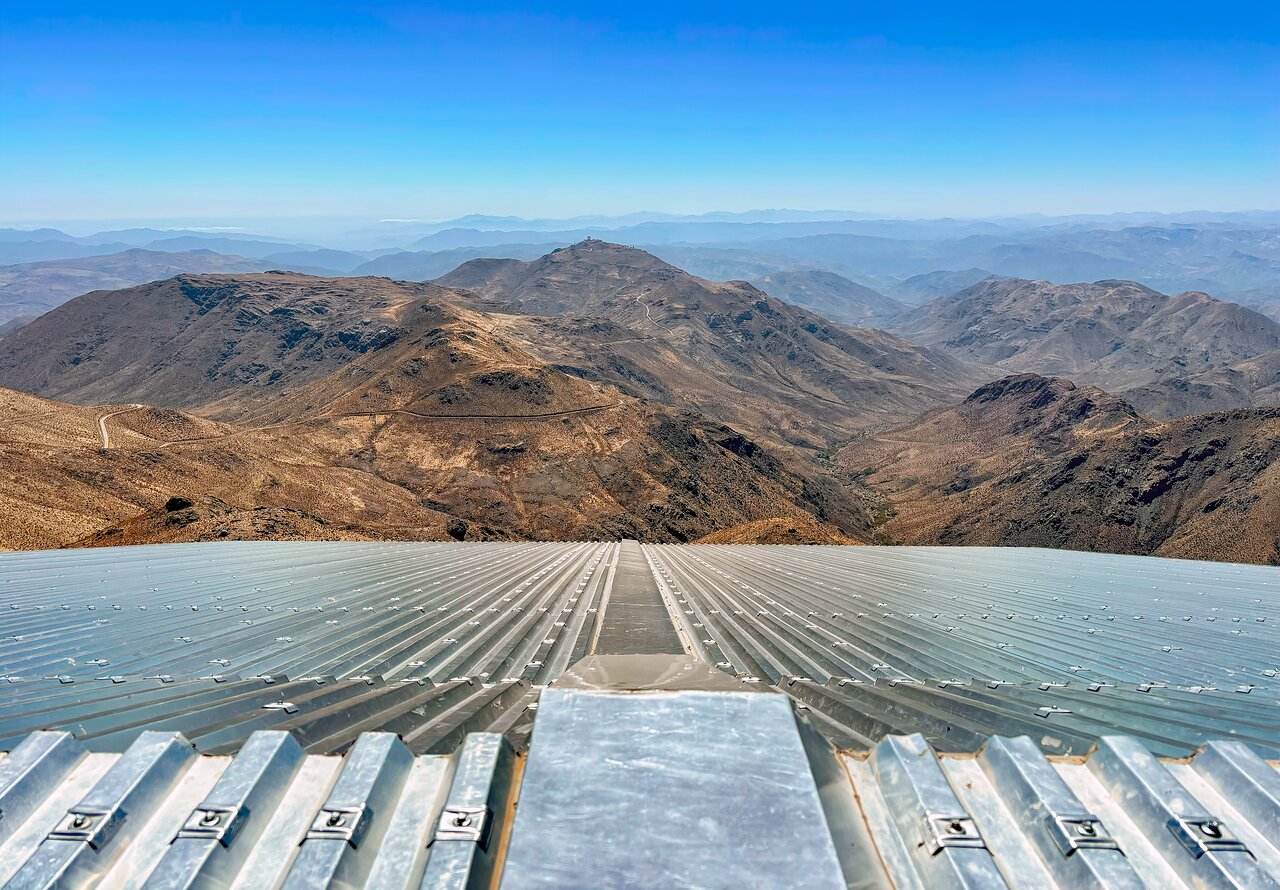
Earthly Expanse Around Rubin
Autorzy: NSF–DOE Vera C. Rubin Observatory/NOIRLab/SLAC/AURA, CC BY 4.0
This unique view can only be seen by looking northwest from the very top of the dome of NSF–DOE Vera C. Rubin Observatory. With clear skies above and the sprawling foothills of the Chilean Andes below, Rubin gives us a front-row seat to magnificent views of Earth and the cosmos. Rubin Observatory is jointly funded by the U.S. National Science Foundation (NSF) and the U.S. Department of Energy's Office of Science (DOE/SC). In the center of the distant mountain peak, you can also see the silver dome of the NSF Víctor M. Blanco 4-meter Telescope, part of the NSF Cerro Tololo Inter-American Observatory (CTIO), a Program of NSF NOIRLab. Chile is a great place to collect high-quality astronomical observations not only due to its arid climate and dark skies, but also its advanced infrastructure. The local governments of Coquimbo and La Serena facilitated safe transport of huge pieces of Rubin’s equipment through populated areas during construction of the summit facility. Data from Rubin travels through the national fiber-optic network of the Research and Education Network of Chile (REUNA). Chile has some of the fastest fixed-broadband internet speeds in the world, which observatories rely on to send their data to researchers and the public around the world. For Rubin specifically, this extensive infrastructure allows data to be sent from Cerro Pachón to SLAC National Accelerator Laboratory in California for processing within about seven seconds of image capture. Thanks to these important partnerships, Rubin and Chile are ready to capture the cosmos.
Tytuły, opisy i podpisy autorów są pokazane po angielsku, tak jak publikuje je źródło.
Zobacz w NSF NOIRLab