James Webb Space Telescope: plan na ten tydzień
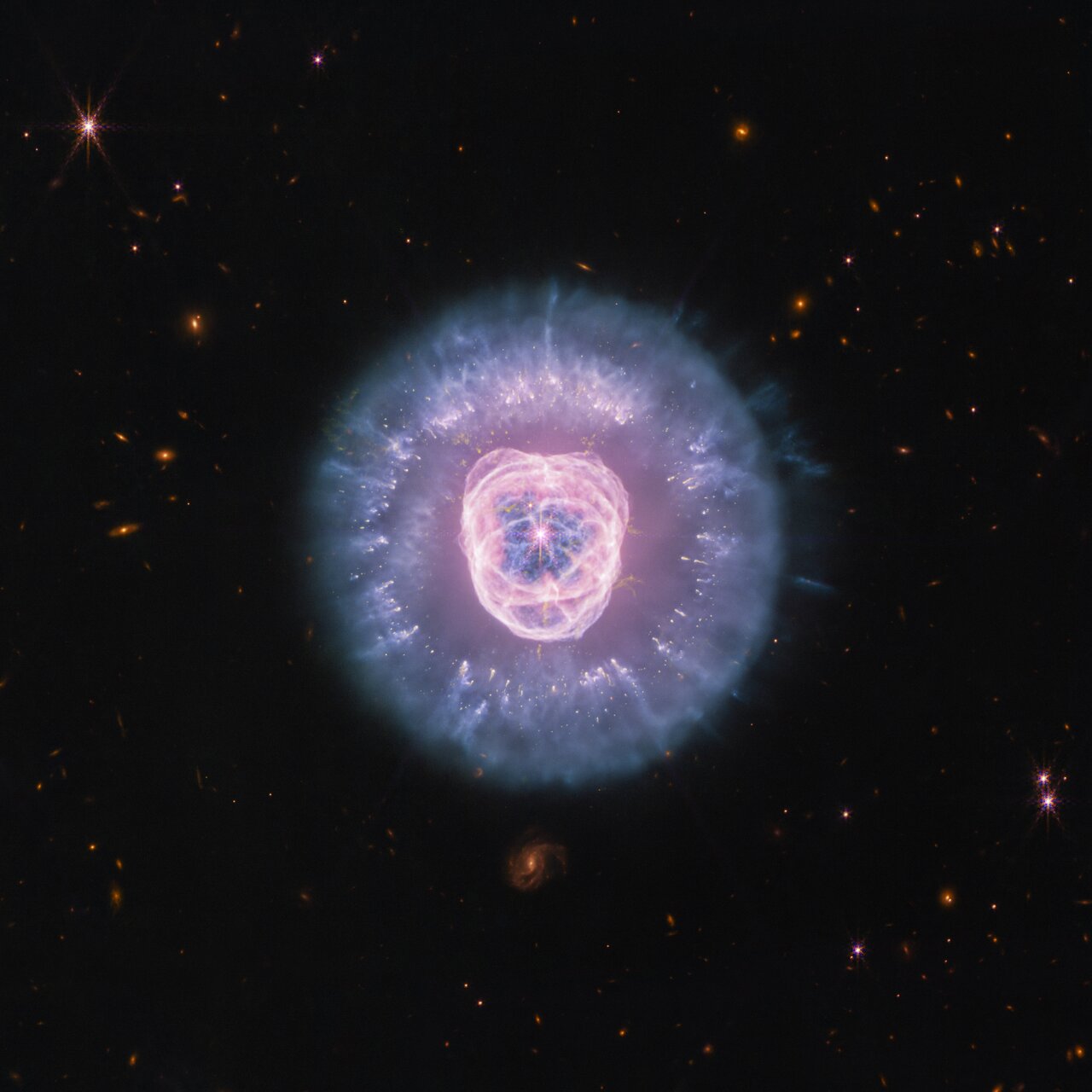
To jest zdjęcie z Webba
NGC 2392 (Lion Nebula)
Dawna nazwa: Eskimo Nebula
Webb widzi podczerwień, czyli ciepło, a nie światło dostrzegalne okiem, więc nie było tu koloru do sfotografowania. Każda barwa na tym zdjęciu odpowiada jednej z długości fal zarejestrowanych przez Webba, i tak właśnie niewidzialne światło staje się widzialne.
Co oznacza każda barwa
Mikrometr (µm) to tysięczna część milimetra. Oko przestaje widzieć przy około 0,7, więc każda z poniższych długości fali jest poza jego zasięgiem.
- Niebieski: 1,15 µm (NIRCam)
- Cyjan: 1,87 µm (NIRCam)
- Żółty: 2,12 µm (NIRCam)
- Pomarańczowy: 3,35 µm (NIRCam)
- Czerwony: 10 µm (MIRI)
Opublikowano: 2026-08-10
Autorzy zdjęcia: NASA, ESA, CSA, STScI. Image Processing: A. Pagan (STScI). CC BY 4.0
Zobacz tę publikację na esawebb.orgPrzeczytaj pełny opis tego zdjęcia autorstwa ESA (po angielsku)
Planetary nebula NGC 2392, also called the Lion Nebula, against the black background of space. The nebula is in the centre, circular in shape, and looks like a male lion’s head. In the very centre is a small, pinkish-white circle with eight-point diffraction spikes, a white dwarf star. Surrounding the star are light purple-pink cavernous bubbles and shell-like rings. The bubbles and shells collectively form an oval with two small, wide arcs near the top, reminiscent of a lion’s face and its ears. What appears to be extended outward from the lion’s face is a thick ring of purple-blue material. The width of the ring is consistent throughout and resembles a mane. The area closest to the lion’s face looks cloudy, while the edges of the mane look like there are clumps of dust with comet-like tails and strands. In the background are distant galaxies and stars. Some galaxies appear as small yellow and orange points of light and others with visible spiral structures. A couple of the stars have diffraction spikes.
Autor opisu: ESA/Webb, CC BY 4.0
To jest plan, nie transmisja na żywo
Żadne publiczne źródło nie podaje, gdzie Webb faktycznie celuje w tej chwili. Poniżej widzisz harmonogram opublikowany wcześniej przez STScI. Część z niego się nie wydarzy: obserwacje okazjonalne, na przykład nagła supernowa, mogą w ostatniej chwili odsunąć zaplanowane cele.
Since the schedules do not take into account unforeseen events, including some target of opportunity observations, it is possible that the actual executed observations will differ from those planned.Wczytywanie harmonogramu na ten tydzień.