James Webb Space Telescope: o plano desta semana
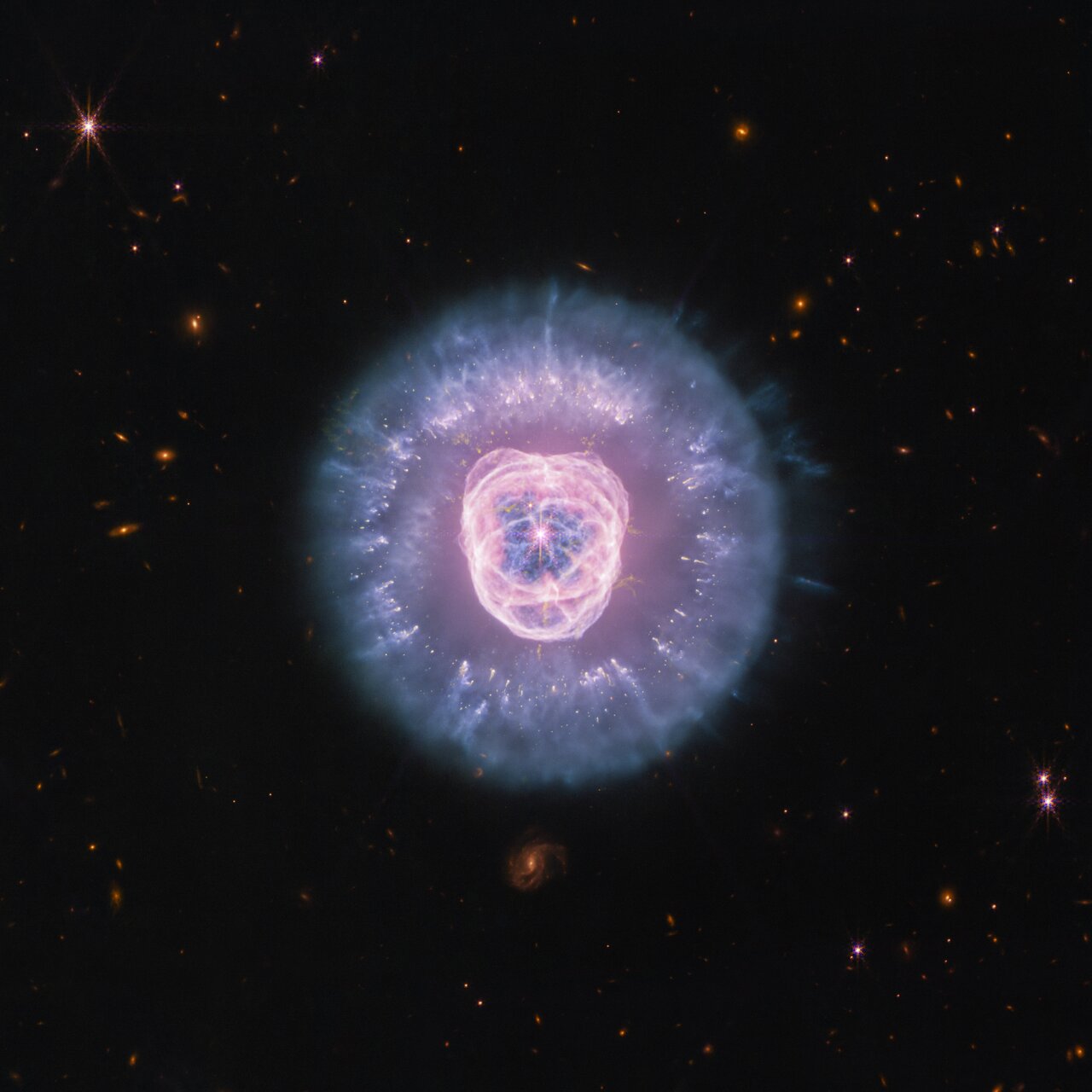
Esta é uma imagem do Webb
NGC 2392 (Lion Nebula)
Nome anterior: Eskimo Nebula
O Webb vê infravermelho, que é calor e não luz que o seu olho consiga detetar, por isso não havia aqui cor para fotografar. Cada cor desta imagem representa um dos comprimentos de onda que o Webb registou, e é assim que a luz invisível se torna visível.
O que representa cada cor
Um micrómetro (µm) é a milésima parte de um milímetro. O seu olho deixa de ver por volta de 0,7, pelo que todos os comprimentos de onda seguintes ficam para lá disso.
- Azul: 1,15 µm (NIRCam)
- Ciano: 1,87 µm (NIRCam)
- Amarelo: 2,12 µm (NIRCam)
- Laranja: 3,35 µm (NIRCam)
- Vermelho: 10 µm (MIRI)
Publicada: 2026-08-10
Crédito da imagem: NASA, ESA, CSA, STScI. Image Processing: A. Pagan (STScI). CC BY 4.0
Ver esta publicação em esawebb.orgLer a descrição completa desta imagem feita pela ESA (em inglês)
Planetary nebula NGC 2392, also called the Lion Nebula, against the black background of space. The nebula is in the centre, circular in shape, and looks like a male lion’s head. In the very centre is a small, pinkish-white circle with eight-point diffraction spikes, a white dwarf star. Surrounding the star are light purple-pink cavernous bubbles and shell-like rings. The bubbles and shells collectively form an oval with two small, wide arcs near the top, reminiscent of a lion’s face and its ears. What appears to be extended outward from the lion’s face is a thick ring of purple-blue material. The width of the ring is consistent throughout and resembles a mane. The area closest to the lion’s face looks cloudy, while the edges of the mane look like there are clumps of dust with comet-like tails and strands. In the background are distant galaxies and stars. Some galaxies appear as small yellow and orange points of light and others with visible spiral structures. A couple of the stars have diffraction spikes.
Crédito do texto: ESA/Webb, CC BY 4.0
Isto é um plano, não uma transmissão ao vivo
Nenhuma fonte pública informa para onde o Webb esta realmente apontando agora. O que você ve abaixo é o programa que o STScI publicou com antecedência. Parte dele não vai acontecer: alvos de oportunidade, como uma supernova repentina, podem deslocar observações planejadas em cima da hora.
Since the schedules do not take into account unforeseen events, including some target of opportunity observations, it is possible that the actual executed observations will differ from those planned.Carregando o programa desta semana.